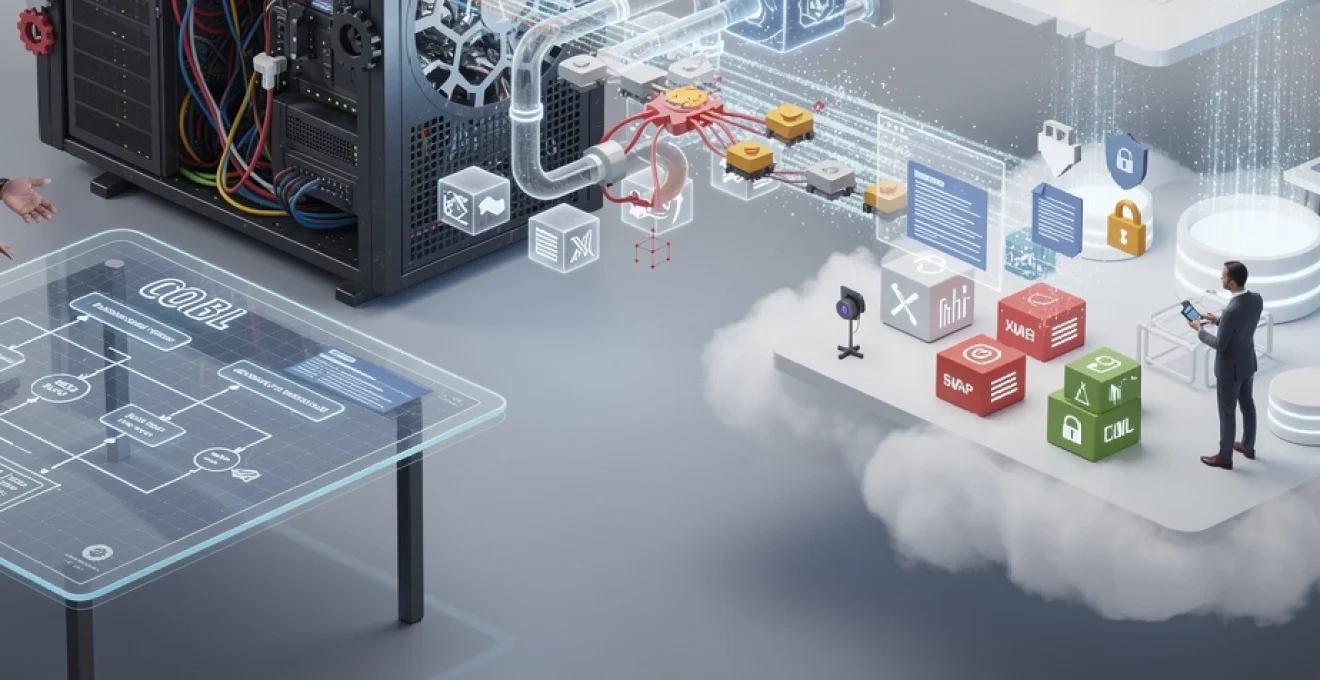
Legacy systems continue to form the backbone of many enterprise operations, yet they present formidable obstacles when organisations attempt to modernise their technology infrastructure. These systems, often decades old, were built during an era when business requirements, security protocols, and integration capabilities were vastly different from today’s interconnected digital ecosystem. The challenge becomes particularly acute when attempting to bridge the gap between established mainframe environments and contemporary cloud-native architectures.
The complexity of modernising legacy infrastructure extends far beyond simple software upgrades. It encompasses intricate technical dependencies, architectural paradigms that no longer align with modern development practices, and integration challenges that can paralyse digital transformation initiatives. Understanding these challenges is crucial for organisations seeking to maintain competitive advantage whilst preserving the reliability and functionality of their core business systems.
Technical debt accumulation in COBOL and mainframe environments
Technical debt in legacy systems represents one of the most significant barriers to successful digital transformation. This accumulated debt manifests through decades of quick fixes, patches, and modifications that have created a complex web of interdependencies. In mainframe environments running COBOL applications, this debt becomes particularly problematic as original system architects have often retired, leaving behind systems with limited documentation and institutional knowledge.
The financial impact of technical debt in enterprise environments is staggering. Research indicates that organisations typically allocate between 60-80% of their IT budgets to maintaining existing systems rather than investing in innovation. This allocation severely constrains an organisation’s ability to adapt to changing market conditions and customer expectations. The situation becomes more challenging when considering that many critical business processes rely entirely on these legacy systems, making wholesale replacement both risky and expensive.
Code coupling dependencies in IBM z/OS systems
IBM z/OS systems present unique challenges due to their tightly coupled architecture, where components are intricately interconnected through shared data structures and procedural calls. This tight coupling makes it extremely difficult to isolate individual components for modernisation without affecting the entire system’s functionality. The interdependencies often extend across multiple applications, creating a domino effect where changes to one component can have unexpected consequences throughout the system.
The modular approach that modern software development embraces becomes nearly impossible to implement when dealing with such tightly coupled systems. Each modification requires extensive impact analysis, comprehensive testing across all dependent systems, and careful coordination between multiple development teams. This complexity significantly increases both the time and cost associated with any modernisation effort.
Database schema rigidity in DB2 and IMS hierarchical structures
Traditional database systems like DB2 and IMS utilise rigid hierarchical structures that were designed for the computing limitations of previous decades. These structures, whilst efficient for specific types of data operations, create significant challenges when organisations attempt to implement more flexible, modern data architectures. The hierarchical nature of these systems makes it difficult to establish relationships between data elements that don’t fit the predefined hierarchy.
Modern applications often require flexible data models that can adapt to changing business requirements and support complex relationships between different data entities. The rigid schema structures of legacy databases can become a significant bottleneck, requiring extensive data transformation processes and complex mapping procedures to integrate with contemporary applications and analytics platforms.
Procedural programming paradigms hindering Object-Oriented migration
Legacy systems predominantly utilise procedural programming paradigms, where code is organised as a sequence of functions or procedures that operate on data structures. This approach differs fundamentally from modern object-oriented programming, where data and the methods that operate on that data are encapsulated within objects. The migration from procedural to object-oriented architectures requires not just code translation but a complete rethinking of how business logic is structured and organised.
The procedural approach often results in code that is difficult to maintain, test, and extend. Functions may have numerous side effects, data structures are often global and accessible from multiple points in the application, and business logic becomes scattered across numerous procedures. This makes it challenging to identify discrete business functions that could be extracted and modernised independently.
Hardware-specific assembly code dependencies
Many legacy systems contain critical components written in assembly language that are specifically optimised for particular hardware architectures. These components often handle performance-critical operations or interface directly with hardware resources in ways that cannot be easily replicated in higher-level programming languages. The hardware-specific nature of this code creates significant barriers when organisations attempt to migrate to different platforms or cloud
environments. In many cases, even minor changes to assembly routines can introduce subtle timing or concurrency issues that are extremely difficult to diagnose. As organisations move towards virtualised infrastructure and cloud platforms, these low-level dependencies become increasingly fragile, as the underlying hardware abstraction layers behave differently from the original mainframe or proprietary servers for which the code was optimised.
To mitigate these hardware-specific dependencies, teams often need to wrap critical assembly routines behind stable interfaces, allowing gradual replacement or reimplementation in higher-level languages. This approach, however, demands deep reverse engineering skills and extensive regression testing to ensure functional equivalence. Without a planned strategy to retire or isolate assembly code, digital transformation projects can stall because no one wants to touch the “black box” components that keep core transactional workloads running.
API integration barriers between legacy SOAP and modern REST architectures
As organisations pursue digital transformation, they frequently need to connect legacy SOAP-based services with modern RESTful APIs. This integration layer becomes a friction point, as the two architectures embody different assumptions about state, payload formats, and contract evolution. Legacy SOAP interfaces were often designed for tightly controlled, internal service consumption, whereas modern REST APIs aim to support external partners, mobile applications, and cloud-native microservices.
The result is an integration patchwork where teams introduce ad hoc gateways, custom adapters, and brittle transformation logic to make old and new systems talk to each other. Over time, this creates a “spaghetti integration” effect that is as hard to maintain as the original monolith. To support scalable digital channels and omnichannel customer experiences, you need a deliberate strategy for modern API management rather than a collection of point-to-point fixes.
XML schema validation conflicts in enterprise service bus implementations
In many enterprises, an Enterprise Service Bus (ESB) was deployed to orchestrate SOAP-based web services and enforce XML schema contracts. As new REST APIs are introduced, they often rely on lighter-weight JSON payloads and more flexible, versioned contracts. This divergence can cause schema validation conflicts when messages traverse the ESB, particularly if shared canonical schemas were designed around rigid XML structures from the early 2000s.
These XML schema constraints can slow down integration projects, as every change to a downstream microservice may require updates to centralised schemas, transformation mappings, and ESB configurations. In effect, the ESB becomes a new bottleneck, replicating the rigidity of the legacy core. A practical approach is to introduce an API gateway and gradually move towards a model where the ESB focuses on legacy SOAP orchestration, while RESTful services are managed through lighter, decentralised contracts and versioning strategies.
Authentication protocol mismatches between LDAP and OAuth 2.0
Legacy enterprise applications frequently rely on LDAP directories and basic authentication mechanisms that predate modern identity standards. By contrast, cloud-native applications and SaaS platforms typically use OAuth 2.0 and OpenID Connect for delegated authorisation and single sign-on. Bridging these authentication protocols can be challenging, especially when you must maintain strict security controls and regulatory compliance.
Without a unified identity and access management (IAM) strategy, users end up juggling multiple credentials, and developers must embed custom authentication logic into each integration. A more sustainable path involves introducing an identity broker or federation service that can speak both “languages” – translating LDAP-based identities into OAuth tokens and vice versa. This not only simplifies integration between legacy systems and modern applications, but also lays the foundation for zero-trust architectures and fine-grained access control.
Message queue incompatibilities in IBM MQ to apache kafka migrations
Messaging backbones are another area where legacy and modern paradigms collide. IBM MQ is widely used in mainframe and midrange environments for reliable, transactional queuing, while Apache Kafka underpins many real-time streaming and event-driven architectures. Migrating from IBM MQ to Kafka is not as simple as switching endpoints; the two systems implement different delivery semantics, ordering guarantees, and error-handling patterns.
For instance, MQ-based applications often assume strict once-and-only-once delivery and synchronous request–reply patterns, whereas Kafka is optimised for high-throughput, append-only logs and eventual consistency. If you try to “lift and shift” MQ patterns into Kafka, you risk reintroducing tight coupling and undermining the benefits of event streaming. A more effective approach is to introduce a bridge or connector layer that gradually shifts workloads, while redesigning message flows to align with event-driven principles and idempotent processing.
Data serialisation format conflicts in JSON-XML transformation layers
Legacy SOAP services typically serialise data as verbose XML documents with strict schemas, while modern REST APIs prefer compact JSON structures. When these systems must interoperate, teams often resort to JSON–XML transformation layers that map between the two formats. Although this seems straightforward on paper, in practice the transformations can become complex, especially when namespaces, attributes, and nested hierarchies are involved.
Each additional mapping rule introduces another point of failure and a new maintenance burden. Over time, you may end up with a fragile translation layer that behaves like an old-fashioned ETL process rather than a clean API gateway. To avoid this, it is useful to establish clear canonical models for core business entities and invest in well-governed transformation libraries or middleware. Think of this as building a “universal adapter” for your data, rather than hand-crafting converters for every new integration.
Monolithic architecture decomposition strategies for microservices transition
Many legacy systems exist as large monolithic applications where business logic, data access, and presentation layers are inseparably intertwined. When organisations aim to adopt microservices, they often underestimate the effort required to safely decompose these monoliths. It is similar to attempting to remodel a house while you are still living in it; you must keep critical functions running even as you tear down and rebuild load-bearing walls.
Successful decomposition strategies start with a clear understanding of domain boundaries and business capabilities. Techniques such as domain-driven design, event storming, and codebase analysis can help you identify cohesive functional clusters that can be extracted into independent services. Instead of attempting a “big bang” rewrite, many teams adopt the Strangler Fig pattern, gradually routing new or refactored functionality away from the monolith and into microservices while the old system continues to operate.
During this transition, it is crucial to manage data ownership and avoid creating a new generation of tightly coupled services. Shared databases, for example, can undermine microservices autonomy and reintroduce coordination challenges reminiscent of the monolith. By designing services with clear APIs, independent data stores, and asynchronous communication where appropriate, you can incrementally reduce the monolith’s footprint and increase system agility without jeopardising stability.
Data migration complexities from relational to NoSQL database systems
Digital transformation often involves moving from traditional relational databases to NoSQL platforms that better support scalability, flexible schemas, and real-time analytics. However, this shift is far from trivial. Decades of business logic, reporting processes, and integration patterns are built around relational assumptions such as fixed schemas, SQL joins, and strict transactional consistency.
When you introduce a NoSQL database, you are not just changing the storage engine; you are altering how applications model and query data. This can have far-reaching implications for performance, data quality, and operational resilience. To navigate this transition, organisations must approach data migration as a strategic programme rather than a one-off technical task, combining careful modelling, phased cutovers, and rigorous validation.
Schema mapping challenges in oracle to MongoDB transformations
Consider the migration from Oracle to MongoDB as an example. Oracle tables with normalised schemas and complex relationships must be transformed into document-oriented models where related entities may be embedded within a single document. While this denormalisation can improve read performance for specific access patterns, it demands a deep understanding of how the application uses the data. Misjudging these patterns can lead to oversized documents, redundant information, or inefficient queries.
Moreover, stored procedures, triggers, and constraints embedded in the Oracle environment must be reconsidered. Do you reimplement them in application code, or use MongoDB features such as aggregation pipelines and validation rules? A robust migration strategy typically starts with a detailed inventory of existing schemas and database objects, followed by pilot projects that test alternative document models against real workloads. By iterating on these models before a full migration, you reduce the risk of locking yourself into a poorly designed NoSQL schema.
ACID compliance preservation during distributed transaction implementation
Relational databases like Oracle and DB2 offer strong ACID guarantees, simplifying transactional logic for application developers. In distributed, cloud-native environments, achieving the same level of consistency across multiple services and data stores is much more complex. Technologies such as NoSQL databases, message brokers, and microservices architectures often favour availability and partition tolerance over strict consistency, following the CAP theorem.
When migrating away from monolithic, ACID-centric systems, you must decide where strong consistency is truly essential and where eventual consistency is acceptable. Techniques like the Saga pattern, compensating transactions, and idempotent operations can help maintain data integrity in distributed transactions without resorting to heavyweight two-phase commit protocols. The key is to model business processes in a way that can tolerate temporary inconsistencies while still providing reliable outcomes to end users.
ETL pipeline restructuring for real-time data streaming architectures
Legacy ETL pipelines were designed for batch processing, often running nightly jobs that moved data from operational systems into data warehouses. In a modern digital enterprise, this model is increasingly insufficient. You may need near real-time analytics, personalised recommendations, or continuous monitoring—all of which require streaming data architectures built on platforms such as Apache Kafka, Apache Flink, or cloud-native equivalents.
Restructuring ETL pipelines for streaming involves more than replacing one tool with another. You must rethink how data is captured, transformed, and consumed. Instead of monolithic batch jobs, you design smaller, event-driven transformations that operate on continuous data flows. This shift can feel like replacing a cargo train with a fleet of delivery vans: you gain agility and responsiveness, but only if you carefully coordinate routes, payloads, and delivery guarantees to avoid chaos.
Primary key relationship modeling in document-based storage solutions
In relational databases, primary and foreign keys define relationships between tables, enabling flexible joins at query time. Document-based stores, however, encourage embedding related data within a single document or linking documents through application-managed references. Choosing the right approach for each relationship is critical to achieving both performance and maintainability.
If you embed too much, documents can grow unwieldy and difficult to update; if you reference everything, you recreate join-like patterns at the application level, which can degrade performance and increase complexity. A common best practice is to embed data that is tightly coupled and frequently accessed together, while referencing entities that are shared or independently updated. By modelling these relationships thoughtfully, you can leverage the strengths of document databases without sacrificing clarity or consistency.
Security vulnerabilities in outdated cryptographic protocols and TLS versions
Legacy systems often rely on cryptographic protocols and TLS versions that are no longer considered secure, such as SSL 3.0 or early iterations of TLS 1.0 and 1.1. Over the past decade, numerous vulnerabilities—BEAST, POODLE, Heartbleed, and others—have highlighted how quickly once-trusted algorithms and ciphers can become liabilities. Yet many mission-critical applications still depend on these outdated stacks because updating them risks breaking compatibility with old clients or tightly coupled components.
This creates a precarious situation where the organisation must choose between security and continuity. Attackers are well aware that legacy environments lag behind on patching and protocol upgrades, making them prime targets for exploitation. To mitigate this, security teams should prioritise an inventory of all cryptographic dependencies, enforce minimum TLS standards at gateways and load balancers, and plan phased deprecation of weak ciphers. In some cases, protocol translation layers can be introduced, allowing legacy applications to communicate using older standards internally while exposing only modern, hardened endpoints to the outside world.
Cloud migration obstacles for on-premises enterprise resource planning systems
Enterprise Resource Planning (ERP) platforms are often at the heart of operational processes, integrating finance, supply chain, HR, and manufacturing. Many of these ERP systems were implemented as large, on-premises installations with extensive customisations and tightly coupled integrations to other legacy applications. When organisations attempt to move these ERPs to the cloud—whether via SaaS, hosted, or hybrid models—they encounter a range of obstacles that can derail migration timelines.
Custom code, bespoke reports, and point-to-point interfaces are among the biggest challenges. Over years or even decades, these enhancements turn a standard ERP into a highly specialised solution that does not map cleanly onto cloud-native equivalents. A direct lift-and-shift approach may preserve functionality but fail to deliver the agility, scalability, and cost optimisation that cloud migration promises. Conversely, a full re-implementation in a modern ERP suite can be disruptive and risky if not preceded by thorough process analysis and stakeholder alignment.
To navigate these obstacles, many organisations adopt a phased strategy. They begin by moving non-critical modules or peripheral workloads to the cloud, establishing secure connectivity between on-premises and cloud environments. Next, they rationalise customisations, retiring those that duplicate standard functionality and re-engineering only the capabilities that deliver clear competitive advantage. Throughout this journey, strong governance and change management are essential, ensuring that users are trained, data quality is maintained, and business operations continue with minimal disruption. By treating ERP cloud migration as a multi-year transformation rather than a one-off project, enterprises can gradually overcome legacy constraints and realise the full benefits of a cloud-first strategy.