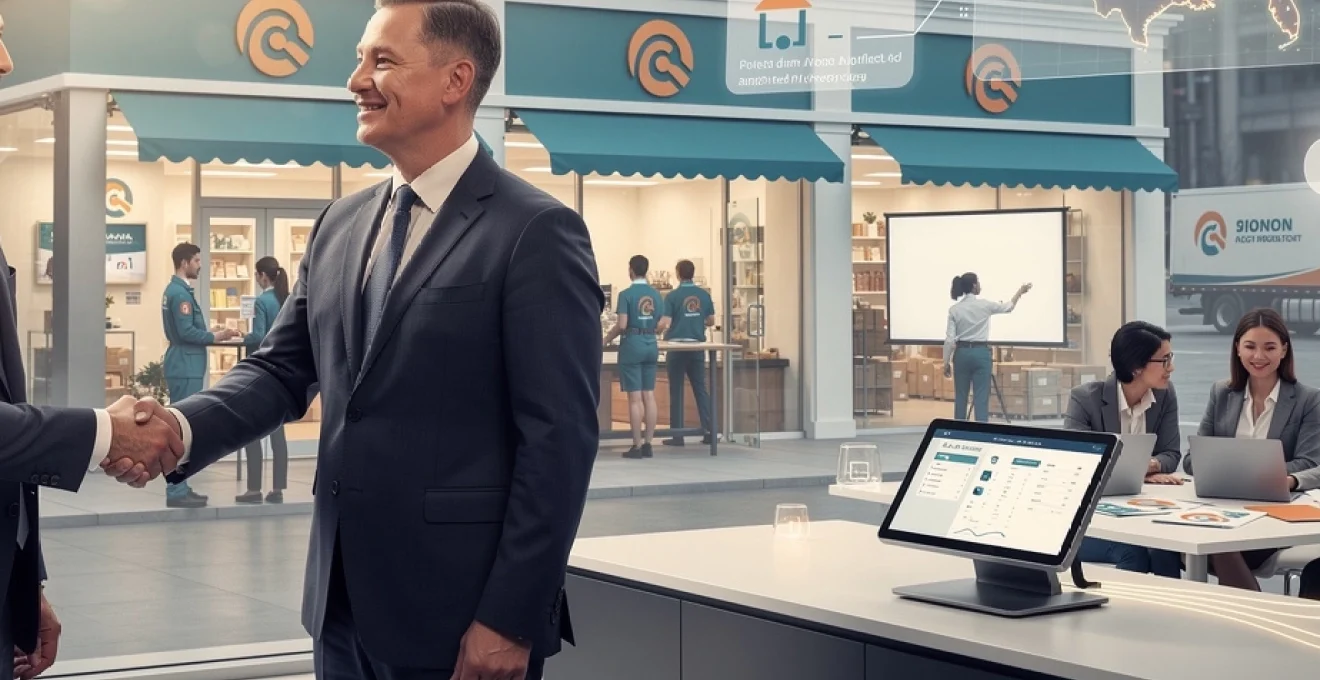
The modern franchise landscape has evolved dramatically from its humble beginnings, with shared branding strategies now representing one of the most powerful mechanisms for business growth and market dominance. When multiple franchise units operate under a unified brand umbrella, they unlock a symphony of advantages that individual businesses simply cannot achieve alone. This collective approach transforms isolated business ventures into interconnected networks of mutual support, shared resources, and amplified market presence.
The concept of shared branding in franchise systems extends far beyond simple name recognition. It encompasses a sophisticated ecosystem where every participating unit contributes to and benefits from collective brand equity, operational efficiencies, and market credibility. From the local coffee shop that gains instant recognition through established brand association to the regional automotive service centre that leverages national advertising campaigns, shared branding creates a multiplicative effect that enhances individual performance whilst strengthening the entire network.
Brand equity accumulation through collective marketing investment
The foundation of successful franchise operations rests upon the principle that collective investment in brand equity generates exponentially greater returns than individual marketing efforts. When franchise operators pool their resources under a shared brand architecture, they create a marketing powerhouse that can compete with the largest corporations in their respective industries. This collaborative approach transforms modest individual marketing budgets into substantial campaigns capable of reaching national audiences and establishing dominant market positions.
Pooled advertising spend amplification across franchise networks
The mathematics of pooled advertising spend creates compelling advantages for franchise participants. When hundreds or thousands of franchise locations contribute to collective marketing funds, the resulting advertising budget can support premium television slots, sophisticated digital campaigns, and comprehensive multimedia strategies that would be financially impossible for individual operators. Consider how a single franchise location might allocate £2,000 monthly for local advertising, but when 500 locations contribute similar amounts, the resulting £1 million monthly budget can secure national television campaigns, celebrity endorsements, and comprehensive digital marketing programmes.
This amplification effect extends beyond simple budget multiplication. Large advertising spends unlock volume discounts from media companies, access to premium advertising slots during peak viewing times, and the ability to maintain consistent brand presence across multiple channels simultaneously. The collective buying power ensures that each participating franchise location receives far more marketing value per pound invested than they could achieve independently.
National media buying power: McDonald’s vs independent restaurant comparison
The stark contrast between franchise network media buying power and independent restaurant capabilities illustrates the transformative impact of shared branding. McDonald’s, with approximately 1,300 UK locations contributing to collective marketing funds, can negotiate television advertising rates that are significantly lower per impression than independent restaurants could ever achieve. Whilst an independent restaurant might pay £15-20 per thousand impressions for local television advertising, McDonald’s network buying power can secure prime-time national television slots at rates as low as £3-5 per thousand impressions.
This differential extends to digital advertising platforms, where McDonald’s can leverage its massive advertising spend to access premium placement opportunities, advanced targeting capabilities, and preferential treatment from platform algorithms. Independent restaurants, competing for the same digital advertising space with limited budgets, often find themselves relegated to less effective time slots and audience segments, creating a competitive disadvantage that compounds over time.
Cross-location brand recognition transfer and consumer recall metrics
The phenomenon of brand recognition transfer represents one of the most valuable aspects of shared branding in franchise systems. When consumers encounter a familiar franchise brand in a new location, they immediately transfer their existing brand associations, trust levels, and service expectations to that new encounter. Research indicates that brand recognition transfer can increase consumer trial rates by 300-400% compared to unknown local competitors, providing new franchise locations with immediate market advantages.
Consumer recall metrics demonstrate the cumulative effect of shared branding across franchise networks. Each customer interaction with any franchise location strengthens brand memory for the entire network, creating a virtuous cycle where increased brand exposure generates higher recall rates, which in turn drive increased customer traffic across all locations. This shared benefit means that a franchise location in Manchester benefits from positive customer experiences at locations in Birmingham, London, or Edinburgh, creating network-wide brand strength that individual businesses cannot replicate.
Shared digital marketing assets and SEO domain authority benefits
The digital marketing advantages of shared branding extend to sophisticated SEO strategies that leverage collective domain authority and content creation resources. Franchise networks can develop comprehensive digital marketing assets including
central websites, content hubs and local landing pages that individual franchisees could not build or maintain alone. High-authority domains built over many years of consistent publishing tend to rank significantly higher in search results than brand-new, single-location websites. When all franchisees publish under the same domain, every blog post, location page and customer review contributes to shared search engine authority, making it easier for each unit to appear for competitive local queries such as “best burger restaurant in Manchester” or “same-day oil change in Birmingham”.
Shared digital marketing assets also reduce duplication and inconsistency. Instead of every franchisee commissioning separate agencies to build websites, write copy and manage pay-per-click campaigns, the franchisor can centralise these functions and roll out proven templates that convert. Franchisees still retain the ability to localise content and keywords, but they do so within a framework that has been technically optimised for speed, mobile usability, schema markup and conversion tracking. The result is a franchise SEO strategy that compounds over time, with every new page and campaign strengthening the entire shared brand rather than diluting effort across dozens of disconnected sites.
Operational cost reduction through standardised brand systems
Beyond marketing, one of the most compelling reasons to operate under a shared brand in a franchise system is the substantial reduction in operational costs. Standardised processes, centralised support functions and unified technology platforms allow franchisees to run leaner operations while maintaining high service levels. Instead of reinventing the wheel in each location, franchisees plug into refined systems that have been tested across hundreds or thousands of units, dramatically shortening the learning curve and lowering the cost of mistakes.
This standardisation does not mean rigidity for its own sake. Rather, it focuses on the behind-the-scenes mechanics that customers rarely see but feel in the consistency of the experience: how stock is ordered, how staff are trained, which suppliers are used, which technology systems are deployed. When everyone follows the same playbook, the shared brand can negotiate better deals, roll out innovation faster and provide deeper support, all of which feed back into individual franchise profitability.
Unified marketing materials development and distribution economies
Marketing collateral is an area where duplication of effort can quietly drain resources from independent operators. In a shared brand environment, the franchisor’s marketing team designs, tests and refines core assets—menu boards, point-of-sale materials, brochures, social media templates and seasonal campaigns—that all franchisees can deploy. Instead of each owner commissioning graphic designers, copywriters and printers, they access a central library of ready-to-use, brand-compliant materials.
Economies of scale kick in most clearly at the production stage. Printing 5,000 menus for one location is expensive; printing 2 million menus for a national network is not only cheaper per unit but also attracts higher quality suppliers and better finishes. Digital distribution is equally efficient. Campaign assets can be pushed through central marketing platforms to every franchisee’s social channels, email lists and local ad accounts in a few clicks. This unified marketing materials system ensures that each franchisee benefits from professionally produced campaigns at a fraction of the cost, while still being able to add local offers or location-specific information.
Centralised brand management teams: subway’s corporate structure model
Global brands like Subway demonstrate how centralised brand management structures underpin effective franchise networks. At corporate level, Subway maintains dedicated teams for brand strategy, menu development, marketing, operations, training and technology. These teams constantly analyse performance data from thousands of locations, test new initiatives in pilot markets and refine the operating model before rolling changes out to the wider network.
For individual franchisees, this means complex strategic decisions are not made in isolation. The shared brand shoulders the burden of long-term planning, market research and competitive analysis. Subway’s central team can identify emerging consumer trends—such as increasing demand for healthier options or digital ordering—and develop coordinated responses: new product lines, app features or in-store design tweaks. Franchisees benefit from a level of professional expertise that would be financially out of reach for a standalone sandwich shop, all while focusing their energy on execution and local relationship building.
Technology platform consolidation: POS systems and CRM integration
Technology is another domain where operating under a shared brand magnifies value. Franchise systems typically standardise on a small number of approved point-of-sale (POS) platforms, customer relationship management (CRM) tools and online ordering systems. This consolidation delivers immediate savings through group licensing agreements, but the deeper value lies in data and integration. When every transaction across the network flows through a unified POS and CRM stack, the brand can analyse customer behaviour at scale, benchmark performance between locations and identify best practices.
From a franchisee’s perspective, centralised technology platforms remove the guesswork from system selection and implementation. You are not left comparing dozens of software vendors or wrestling with complex integrations; instead, you receive a pre-configured toolkit aligned with the brand’s operating model. Features such as loyalty programmes, digital gift cards and automated email campaigns can be switched on quickly, helping you build repeat business without heavy upfront investment. It is the difference between building your own toolkit from scratch and being handed a fully stocked toolbox that has been fine-tuned in real-world conditions.
Supplier negotiation leverage through brand volume purchasing
Perhaps the clearest financial advantage of joining a shared brand is purchasing power. When a franchisor negotiates with suppliers on behalf of hundreds of outlets, it can secure prices and service levels that small independents simply cannot match. This applies not only to core inventory—food ingredients, automotive parts, cleaning products—but also to ancillary costs like packaging, uniforms, signage and even energy contracts in some cases.
Volume purchasing offers more than just lower unit costs. It usually comes with preferential payment terms, guaranteed stock availability and dedicated account management. In sectors where supply chain disruption has become a regular feature, being part of a large buying group can mean the difference between consistent service and empty shelves. For franchisees, this translates into more predictable margins, fewer stock-out headaches and more time to focus on customers rather than chasing suppliers. The shared brand effectively acts as your procurement department, wielding the combined demand of the entire network as a powerful bargaining chip.
Consumer trust transfer and brand credibility mechanisms
Trust is one of the hardest assets to build in business, yet shared franchise brands accumulate it every day across all locations. When you operate under a recognised brand, you benefit from what psychologists call “halo effects”: positive experiences in one context spill over into related contexts. A customer who has consistently good service from a branded hotel in Leeds is far more likely to book the same brand in Bristol without hesitation. This trust transfer significantly lowers the friction of first-time purchase, which is often the biggest barrier for new or lesser-known businesses.
Franchise systems reinforce this trust through visible and invisible mechanisms. Visibly, consumers see consistent branding, familiar layouts and standardised service rituals that signal reliability—think of the recognisable look of a Costa Coffee outlet or a Premier Inn. Invisibly, franchisors back up these signals with rigorous training, operational support and quality checks, giving customers confidence that their experience will be broadly similar wherever they go. For a new franchisee, this means you start trading with a reservoir of goodwill that an independent operator would have to build over many years, if at all.
Franchise territory protection under unified brand architecture
Another major benefit of operating under a shared brand is the protection of your trading area. Most franchise agreements include defined territories—geographic zones within which the franchisor agrees not to open competing outlets of the same brand. This territory protection helps prevent destructive internal competition and gives each franchisee a clear area in which to build market share and invest in local marketing with confidence.
Under a unified brand architecture, territory mapping can be approached scientifically. Franchisors analyse population density, demographic data, traffic patterns and existing store performance to design territories that are both fair and commercially viable. You are not left guessing whether a neighbouring store will cannibalise your sales, because the shared brand has a vested interest in balancing network coverage with individual profitability. In multi-brand groups, there may also be cross-brand territory strategies, ensuring that complementary brands can coexist in the same catchment without eroding each other’s customer base.
Quality control enforcement through brand standard compliance protocols
Consistency is the lifeblood of a strong franchise brand. Customers return because they know what to expect, whether they are visiting a restaurant, a gym or a car service centre. To protect this consistency, franchisors implement robust quality control systems that monitor, measure and enforce brand standards. While this oversight can feel demanding at times, it is precisely what keeps the shared brand valuable—and what makes your own investment more secure.
Quality control protocols typically cover product specifications, service delivery, health and safety compliance, cleanliness, branding execution and even elements such as music volume or lighting levels. By codifying these details in operations manuals and enforcing them through regular checks, the franchisor ensures that one poorly run location does not damage the entire network’s reputation. From your perspective as a franchisee, these standards act like guardrails on a motorway: they may limit some manoeuvres, but they also prevent catastrophic accidents that could harm both you and your fellow operators.
Mystery shopping programmes and brand audit systems
Mystery shopping and structured brand audits are two of the most common tools used to monitor compliance. In a mystery shopping programme, trained evaluators visit locations posing as regular customers and assess service against a predefined checklist: greeting, wait times, product presentation, upselling, problem resolution and more. Because staff do not know when they are being assessed, franchisors get a realistic snapshot of everyday performance rather than a staged demonstration.
Brand audits are typically more comprehensive and may be conducted by field consultants or independent agencies. They review everything from back-of-house hygiene and stock rotation to documentation, training records and adherence to promotional campaigns. While it can be daunting knowing your business may be scored several times a year, high-performing franchisees often welcome these visits as an opportunity to benchmark themselves and identify improvement areas. When mystery shopping scores and audit results are shared across the network (anonymised where appropriate), they also create a culture of continuous improvement and healthy competition.
Trademark protection and legal brand defence strategies
Operating under a shared brand also means benefiting from the franchisor’s legal protection of that brand. Registered trademarks for names, logos, slogans and even distinctive packaging ensure that competitors cannot easily imitate the brand’s identity. The franchisor typically monitors markets for infringements and takes legal action when necessary, defending the value of the brand on behalf of all franchisees. If you were trading as an independent, you would have to fund and manage such actions alone—often an impossible undertaking for a small business.
Legal brand defence extends beyond trademark enforcement. Franchisors may maintain detailed brand guidelines, approve suppliers of signage and packaging to prevent off-brand copies, and require legal review of local marketing initiatives that use the brand name. Although this oversight can feel restrictive when you want to launch a quick promotion, it exists to ensure that no well-intentioned but poorly executed campaign undermines the brand’s positioning, misleads customers or exposes the network to regulatory risk. By pooling legal resources at the franchisor level, every franchisee gains access to robust protection that shields their investment in the brand.
Franchisee training standardisation: KFC’s university model
Training is one of the most powerful levers for quality control, and shared brands increasingly use formal “universities” to standardise learning. KFC, for example, operates a structured training ecosystem often referred to as the KFC University model. New franchisees and managers undergo intensive programmes covering everything from kitchen operations and food safety to leadership, financial management and brand values. Much of this training is delivered through a blend of classroom sessions, e-learning modules and on-the-job coaching at flagship stores.
Standardised training ensures that every KFC outlet, whether in London or Lagos, has leaders who understand the same core processes and performance expectations. For you as a franchisee, this dramatically reduces the trial-and-error phase that independent operators face. You inherit a curriculum refined over decades, along with continual updates as menu items, technology and regulations evolve. In practice, this means fewer operational mistakes, faster ramp-up to profitability and a deeper talent pipeline, as your team can progress through structured learning paths rather than ad hoc instruction.
Product consistency monitoring and supply chain brand standards
Customers expect the same product quality every time they visit a branded outlet. Achieving that consistency across multiple locations and even countries requires tight coordination of recipes, specifications and supply chains. Franchisors typically define detailed product standards—exact ingredient lists, approved suppliers, preparation methods, cooking times and presentation guidelines—and then audit adherence regularly. In food franchises, for instance, even minor deviations in cooking temperature or portion size can alter taste and value perception, so these details are specified with scientific precision.
Supply chain brand standards are enforced through approved vendor lists, central distribution centres and periodic product testing. Ingredients or components are sampled and checked against quality benchmarks, with non-compliant batches rejected before they reach customers. For franchisees, this centralised oversight reduces the risk of product recalls, food safety incidents or reputation-damaging variances. You can focus on execution in-store, confident that the inputs you receive meet the brand’s standards. It is akin to a professional chef having confidence in the reliability of their mise en place—because the foundations are solid, the final dish can be delivered consistently at scale.
Market entry acceleration through established brand recognition
All of these mechanisms—collective marketing, operational systems, trust transfer, territory protection and quality control—combine to deliver one overarching benefit: faster market entry. When you launch under an established shared brand, you bypass the slow, uncertain process of building awareness from scratch. Instead, you step into a market with a recognisable name, proven offering and clear positioning, giving you a running start compared with independent competitors.
In practical terms, this accelerated market entry shows up in shorter payback periods, higher opening week revenues and faster word-of-mouth growth. Customers are more willing to try a new branch of a known franchise, landlords are more inclined to offer favourable terms to credible brands, and lenders often look more positively on financing requests backed by proven franchise systems. Of course, success is never guaranteed—you still need to execute well, hire the right people and engage with your local community. But operating under a shared brand in a franchise system significantly tilts the odds in your favour, turning what might have been a lonely entrepreneurial journey into a collaborative, data-driven and well-supported path to growth.